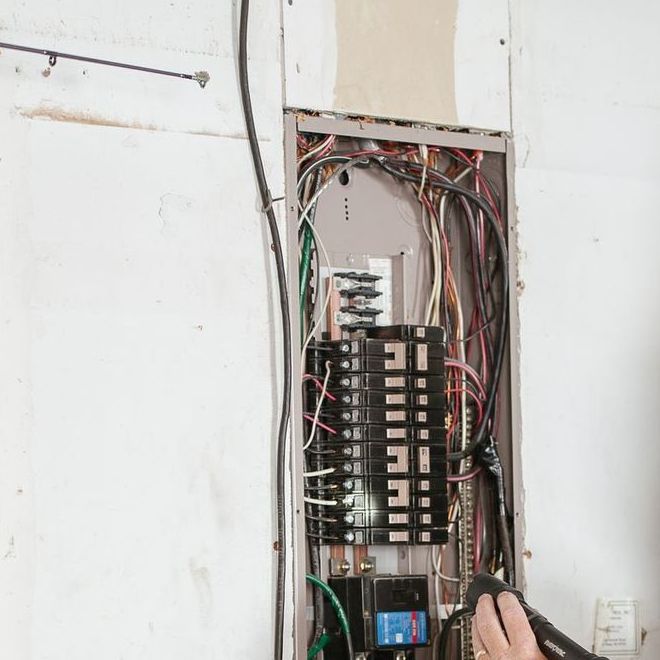
A panel upgrade is the single most quoted, and most over-quoted, job in residential electrical work. Some Raleigh houses genuinely need one. Plenty get sold one because the homeowner could not tell the difference. This guide is meant to fix that.
Craver Electric replaces panels and upgrades services across Raleigh and Wake County. 100 to 200 amp upgrades, Federal Pacific and Zinsco replacements, aluminum wiring repair, knob and tube removal and whole-home rewires, permitted through the City of Raleigh or Wake County and coordinated with Duke Energy. Request a written quote and hear back the same business day.
The rest of this page is the homeowner's guide to the job, so you know what you are buying before you buy it from anyone, including us.
What the panel actually does
The panel is where the power from Duke Energy's meter is split into the circuits that run your house. The main breaker at the top sets the ceiling for the whole home, usually 100, 150 or 200 amps. Every breaker below it protects one circuit by tripping when that circuit pulls more current than its wire can safely carry.
Two things matter when someone tells you the panel needs replacing: whether the main capacity is actually too small for how you live, and whether the panel itself is safe. Those are separate questions and they get blurred together in a lot of quotes.
Signs the capacity is genuinely too small
- You are adding a large new load: a Level 2 EV charger, a heat pump, an electric range replacing gas, a hot tub, or a workshop.
- The panel is 100 amps and the house has grown, a common situation in Raleigh's 1960s and 1970s neighborhoods where additions and finished attics were wired onto the original service.
- There are no open breaker spaces left, and the previous solution was tandem breakers or a subpanel wedged in somewhere odd.
- The main breaker trips on its own, which is different from one branch breaker tripping.
A licensed electrician can do a load calculation for your house. It is arithmetic based on square footage and your appliances, not a judgement call, and it tells you whether the service is actually undersized. Ask for it. A contractor who cannot show you the calculation is guessing.
Signs the panel itself is the problem
Capacity aside, a panel can be unsafe because of its age, its brand or its condition.
- Brand. Two brands, Federal Pacific Stab-Lok and Zinsco, come up in home inspection reports often enough that it is worth knowing which one you have. Both were installed widely in homes built through the 1970s and early 1980s. If your panel carries either name, that alone is a reasonable reason to have it evaluated.
- Heat and corrosion. Scorch marks around a breaker, a warm panel cover, rust at the bottom of the enclosure, or a burning smell are all reasons to call someone this week rather than this year.
- Double-tapped breakers. Two wires landed under one breaker screw that is only rated for one. Common, cheap to fix, and a sign the previous work was rushed.
- A fuse box. Some older Raleigh homes still have one. Fuses work, but the box is usually undersized for a modern house and most insurers want to know about it.
Do not open the dead front. The gray cover with the breakers poking through can be removed by a homeowner with a screwdriver, and behind it are bare bus bars carrying the full service current. Everything in this guide can be read from the outside of the panel or the breaker labels.
What a panel upgrade involves
A full service upgrade, for example 100 amps to 200 amps, is a bigger job than swapping the box. It typically includes:
- New service entrance conductors from the meter to the panel, sized for the new capacity.
- A new meter base, in many cases, because the old one is rated for the old service.
- The new panel, with every existing circuit moved over and labeled.
- A grounding electrode system that meets the current code, which older homes often lack.
- Coordination with Duke Energy to disconnect and reconnect at the meter.
A like-for-like panel replacement at the same amperage skips the service conductors and meter work and is a smaller job. Make sure a quote says which one you are getting.
Permits and inspections in Raleigh
Panel replacements and service upgrades require an electrical permit and an inspection. Inside Raleigh city limits, permits go through the City of Raleigh; in unincorporated Wake County and some surrounding towns, they go through Wake County. The contractor pulls the permit under their license, which is the main reason unlicensed work is a bad idea here: there is no permit, so there is no inspection, and the problem surfaces when you sell the house.
North Carolina's electrical code is based on the National Electrical Code with state amendments. The inspector checks the work against it. This is a good thing for you. It is a second set of eyes on the most important box in the house, and you did not have to pay extra for it.
Where Duke Energy comes in
Raleigh is Duke Energy territory. For a service upgrade, the utility has to disconnect power at the meter so the electrician can work on the service entrance, then reconnect once the inspection is passed. Your electrician arranges this. Expect the house to be without power for part of the day. If the meter base is being replaced, that is also coordinated with the utility.
Rewiring: when the panel is not the whole story
Sometimes the panel is fine and the wiring behind the walls is the concern. Three situations come up in Raleigh houses:
- Knob and tube in homes built before roughly 1950, including some of the older houses in neighborhoods like Oakwood and Boylan Heights. It has no ground and was never designed to be buried in insulation.
- Aluminum branch wiring in homes built between roughly 1965 and 1973. The issue is at the connections, not the wire itself. There are accepted repair methods that do not require ripping out walls.
- Ungrounded two-prong outlets throughout an older house, which usually means the wiring has no ground conductor.
A full rewire is a major project and rarely the first answer. Get the specific problem diagnosed before anyone quotes you for the whole house.
Questions to ask before you sign
- Is this a service upgrade or a same-amperage panel replacement?
- Can I see the load calculation?
- Is the permit included, and who is pulling it?
- Is a new meter base or grounding included?
- What is the license number on the quote?
If those five answers are clear, you are dealing with someone who knows the job. If they are not, get another quote.
Ready for a written price? Describe what the house is doing on the quote form and you will hear back the same business day.